Due at Signing vs. Down Payment on a Car Lease: What's the Difference?
Lease like an expert
By Thomas Horey · Published September 1, 2026 · Updated October 23, 2026
"Due at signing" is the total cash that leaves your pocket when you sign a lease: taxes, fees, the first month's payment, and any down payment. A "down payment" is only the optional extra you choose to pay to lower your monthly bill. That's why a "$0 down" ad can still cost you thousands at the desk.
Key takeaways
- Down payment = one optional line item. Due at signing = everything, including that line item.
- Always ask: "Does this include all taxes, fees, and the first month's payment?" If the answer isn't a clear yes, you don't have a real quote.
- Get every quote in writing. A dealer who will "only quote you in the showroom" is telling you something.
- To compare offers with different amounts due at signing, use the effective monthly payment, not the advertised payment.
What does "due at signing" actually include?
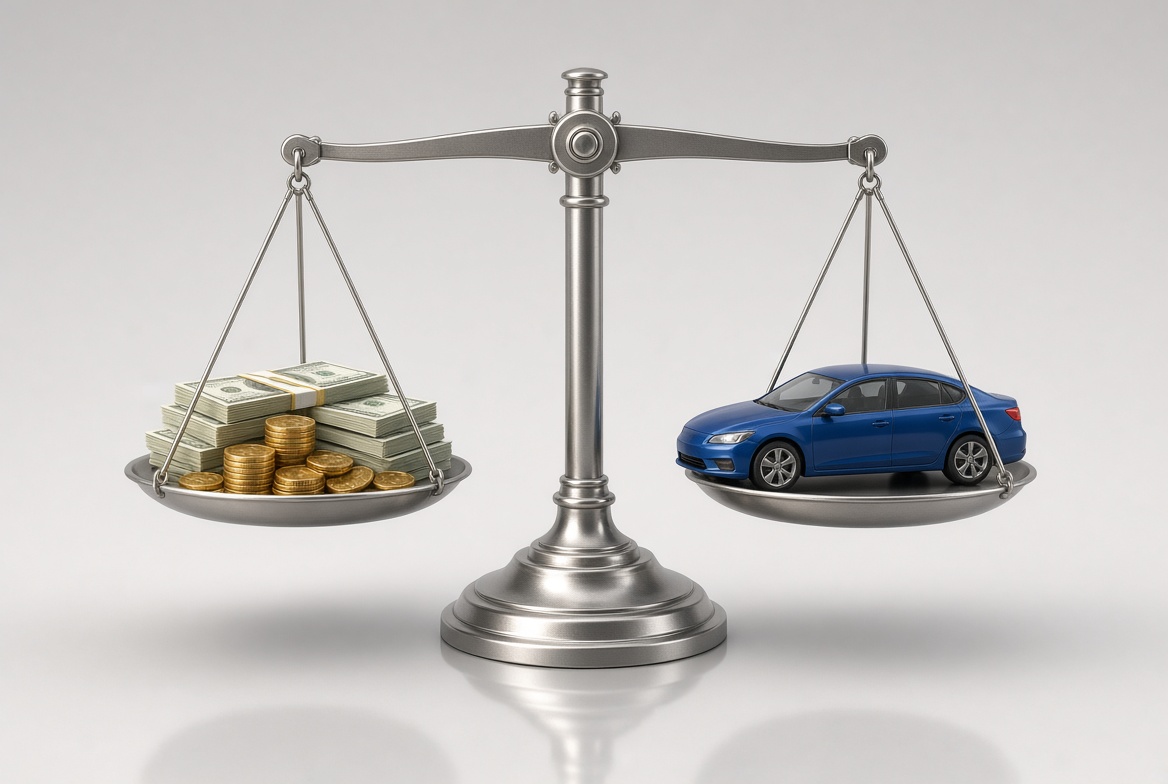
Due at signing (dealers also call it "drive-off," "cash due at delivery," or "inception fees") is the sum of every dollar collected before you get the keys. On most leases it's made up of six things:
| Line item | What it is | Typical range |
|---|---|---|
| First month's payment | Lease payments are paid in advance, so month one is collected at signing. | One payment |
| Acquisition (bank) fee | The leasing company's fee for setting up the lease. Can be rolled into the payment instead. | $595–$1,095 |
| Dealer documentation fee | Dealer's paperwork fee. Capped by law in some states (New York caps it at $175), uncapped in others (Florida). | $85–$1,000+ |
| DMV, title and registration | State fees passed through at cost. | $150–$500+ |
| Sales tax | In New York and New Jersey the tax on the entire lease is due upfront (or capitalized). In Florida and Connecticut it's charged monthly. How New York lease tax works. | $0 to several thousand |
| Down payment (cap cost reduction) | Optional money you put in to lower the monthly payment. | $0 to whatever you choose |
Some lenders also collect a refundable security deposit, and some deals include the first month's payment as a "waived" incentive. But the principle holds: due at signing is always the total.
What is a down payment on a lease, and why is it different?
A lease down payment is formally a "capitalized cost reduction." You're prepaying part of the car's depreciation so the remaining payments are smaller. Put $3,600 down on a 36-month lease and your payment drops by about $100 a month, plus a little interest saved.
Three things make it different from due at signing:
- It's optional. Taxes, fees and the first month are not - but can be rolled into the payment.
- It's gone if the car is totaled. If the car is stolen or wrecked in month four, the leasing company is made whole by insurance and GAP coverage; your down payment is not refunded. (This is the real reason you'll hear "never put money down on a lease" — see what GAP insurance covers.)
- In New York and New Jersey it's taxed. A $3,000 down payment in New York City costs $3,266 once the 8.875% sales tax is applied to it.
Why do "$0 down" lease ads still cost thousands at the desk?
Because the ad is quoting the down payment, not the due at signing. "$0 down" only promises that the optional line is zero. Taxes, the acquisition fee, the doc fee, DMV fees and the first month are all still collected. In practice a "$0 down" lease in the New York area usually runs $1,500 to $4,000 due at signing, depending on the car and the sales tax.
The ads aren't necessarily lying. They're answering a question you didn't ask.
Why should you always get a lease quote in writing?
If I could give car shoppers only two pieces of advice, they'd be these.
First: get every quote in writing. Never rely on a number from a phone call. If you like negotiating on the phone, fine — but ask them to confirm it by email or text immediately afterward. And if a dealer tells you "we only quote people in the showroom," run for the hills. There's exactly one reason to refuse a written quote, and it isn't to save you money.
Second: ask whether the number is a down payment or the total due at signing. I can't tell you how many people get a fantastic quote, drive to the store, sit down to sign, and are told they need to come up with another $3,000 for "taxes and fees." At that point you've taken the afternoon off, you've mentally bought the car, and the salesperson knows it.
[THOMAS: one real anecdote here would make this section — a customer who came to you after exactly this happened. What car, roughly what the gap was, what the dealer said. 3–4 sentences, no names needed.]
[TikTok embed here]
What should a written lease quote include?
A real quote is a worksheet, not a monthly number. Before you compare anything, make sure it shows all of the following:
- Year, make, model, trim, and MSRP (ideally the VIN or stock number)
- Selling price, and the discount from MSRP
- Every rebate or incentive being applied, listed separately (loyalty, conquest, lease cash)
- Money factor (the interest rate) and residual value
- Term and mileage allowance (36 months / 10,000 miles a year, for example)
- Monthly payment including tax
- An itemized total due at signing: first payment, acquisition fee, doc fee, DMV fees, sales tax, and any down payment
- The sentence "This includes all taxes, fees, and the first month's payment," or the dealer's equivalent
If any of those are missing, ask. If the dealer won't provide them, that's your answer.
Pro tip: the phrase that gets the most honest response is "Can you send me the total due at signing, including all taxes, fees, and the first month?" It signals that you know the difference, and it leaves no room for a surprise later.
How do you compare two quotes with different amounts due at signing?
You can't compare $450 a month with $3,000 due at signing against $400 a month with $6,000 due at signing by looking at the payment. You convert both to an effective monthly payment: spread the upfront cash across the term and add it to the payment.
The formula is (monthly payment × (term − 1) + due at signing) ÷ term. Using it, the first quote works out to about $521 a month and the second to about $556, so the "cheaper" $400 payment is the more expensive lease. Here's the full walkthrough with three real quotes, or skip the math and use the Auto Ninjas lease calculator, which shows the effective payment on every deal.
How Auto Ninjas quotes every deal
Auto Ninjas is a marketplace of pre-negotiated lease deals, headquartered in Cape Coral, Florida, with a team in New York and customers across the Northeast, Florida, and nationwide. Every deal on the site shows the monthly payment with tax and the full amount due at signing — first month, fees, and taxes included — calculated to the penny for your state and county. No showroom visit required to get the number in writing; it's already in writing. Search current deals or see how it works.
[THOMAS: confirm this paragraph is accurate — especially "calculated for your state and county" and whether the deal pages show due at signing before someone submits an inquiry.]
Frequently asked questions
Is due at signing the same as a down payment?
No. The down payment is one optional part of the amount due at signing. Due at signing is the total, including taxes, fees, and the first month's payment.
Does due at signing include the first month's payment?
Almost always, because lease payments are paid in advance. Some promotions waive the first payment; the quote should say so explicitly.
Can you negotiate the amount due at signing?
Partly. Taxes and DMV fees are fixed. The doc fee, acquisition fee markup, and the selling price are negotiable, and you can usually choose to roll fees and tax into the monthly payment instead of paying them upfront.
Is $0 down always better on a lease?
Usually, because money you put down isn't refunded if the car is totaled and, in New York and New Jersey, it's taxed. The exceptions are when you're trying to stay under a payment cap or your credit tier requires it.
What is a "drive-off" cost?
The same thing as due at signing — the term is more common on the West Coast and in dealer ads.
Sources
- Federal Reserve Board, Keys to Vehicle Leasing: Up-front costs
- Federal Trade Commission: Financing or Leasing a Car
- New York State Department of Taxation and Finance, Publication 839 (sales tax on long-term motor vehicle leases)